
Conscious and Unconscious Internalization
Understanding what it takes to discover true Self

At the time of writing this, my daughters are nine and eleven. Like many kids their age, they are drawn to watching media and playing video games. What they are not drawn to is piano practice, which is why I’ve made it mandatory. It’s not something they chose, but something I consider part of their education—and a positive element in their cognitive and emotional development. I believe in it, and as far as I can tell, there’s at least some science to support that belief.
Each week, a piano teacher comes to our house and gives them 45-minute lessons. She’s wonderful—patient, talented, and by far the best we’ve had. Still, every week is a struggle. Practicing between lessons takes effort, reminders, and some degree of insistence. I’m not always successful, but I try.
My goal isn’t to make them musicians. I would love for piano to touch something in them, to ignite their imagination or sense of discipline. But after several years, I can see that, for now, it hasn’t taken root.
And that raises a real question: what does it mean when something takes?
Like seeds in soil, some things enter us and grow. For some children, music takes—whether it’s piano, violin, drumming, or producing beats on a computer. The music doesn’t just stay external; it moves inward. It becomes a source of joy and expression. It becomes part of who they are.
That is internalization.
Something comes from the outside, finds fertile ground, and begins to grow. Over time, there is no longer a distinction between the Self and the thing that was once external. The line dissolves. The music is no longer something they do—it’s something they are.
This is what I mean by internalization. And this is also how I think about the spiritual path.
Spiritual growth, as I see it, is the conscious process of internalization. We take something in—an idea, a practice, a presence—and slowly, deliberately, we make it our own. We don’t just understand it. We become it.
And this brings us to something essential:
Where there is conscious internalization, there is also unconscious internalization.
Just as we can deliberately take something in, we can also absorb it without knowing. The spiritual path is not just about bringing in the new—it’s about discovering how much we’ve already taken in without awareness.
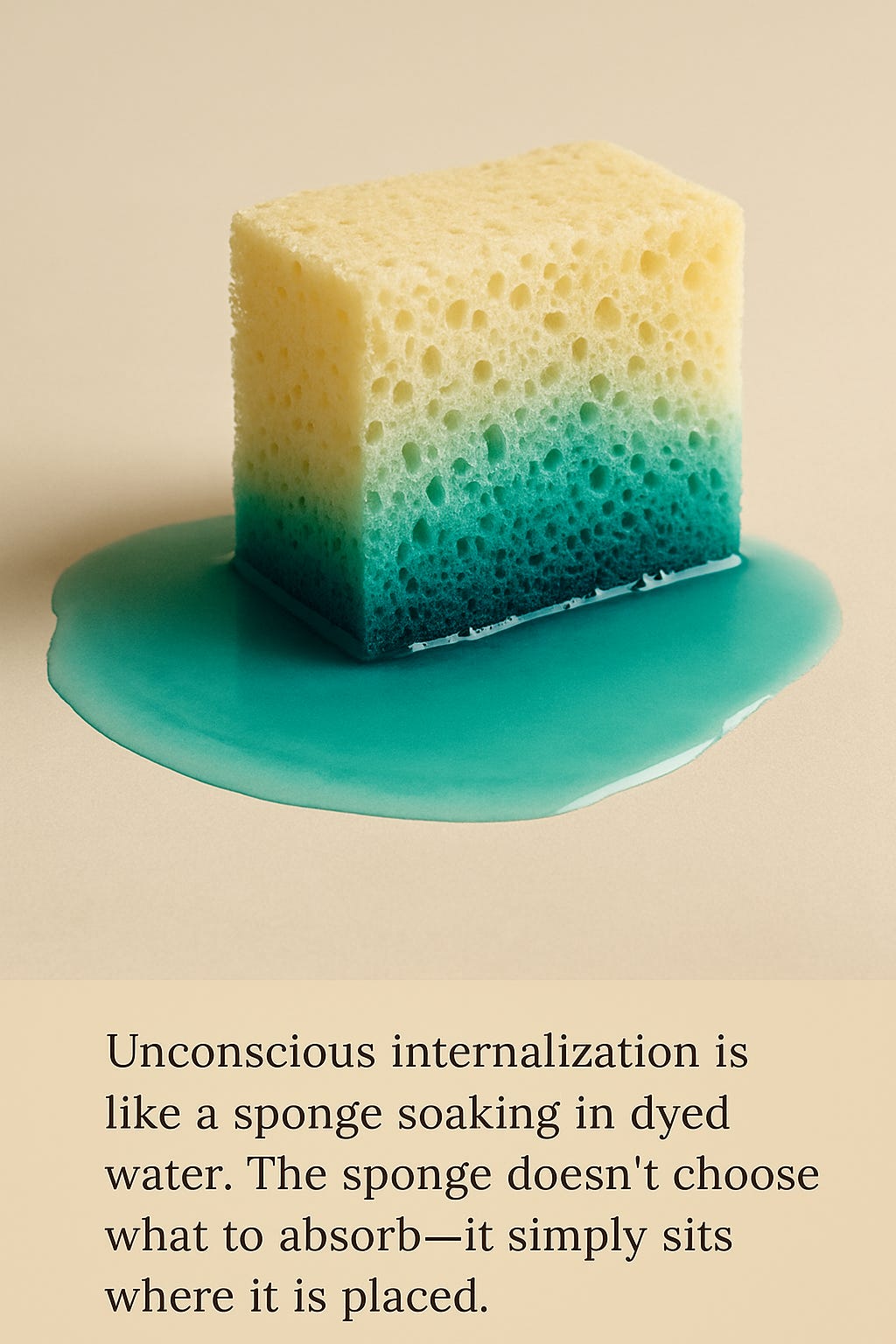
To ground this in something we all share, consider your native language.
You don’t remember learning it. As far as you can tell, you’ve always spoken it. Language was external—spoken around you—but at some point, it crossed the threshold. It became you. Now it moves through you, without effort. You don’t think it—you are it.
This is unconscious internalization. The thing that was added becomes indistinguishable from what you call yourself. You can’t remember when it arrived, and you can’t imagine being without it.
This is your first introduction to the territory of spiritual life.
The spiritual path begins when we start to ask: What have I internalized? What is truly me, and what is borrowed, absorbed, conditioned? Where do I end and my unconscious conditioning begin?
This is where the idea of “conditioning” comes in. But conditioning isn’t just a set of beliefs. It’s what we’ve internalized so completely that we don’t know it came from somewhere else. We think it’s us.
The spiritual aspirant begins to ask: What am I really? Not as an abstraction, but as a lived inquiry. What parts of me were added later? What parts are unexamined inheritance?
We begin to notice the many layers that shape us: some consciously internalized, others passively absorbed. And it’s here that externalization and unconscious internalization begin to converge. Both leave us estranged from the deeper Self. Both bind us to something outside.
And the antidote, if there is one, is conscious internalization.
But this is not easy. It’s a big ask. It requires effort, attention, willingness. And it requires patience, because our default is the opposite.
I see it in my daughters every day. They are already unconsciously internalizing much more than I can track or prevent. The messages they absorb, the values that try to anchor in them, the narratives being sold—it’s all happening with incredible speed and sophistication.
I, too, internalized unconsciously. I spent years trying to undo what had taken root in me before I knew I had a choice. It has taken just as long to begin, slowly, to reclaim that space—to internalize consciously, and begin to colonize myselffrom within.
I cannot unlearn my native language. I cannot erase my upbringing. But that’s not the point.
The point is presence.
Presence is the fruit of conscious internalization. It is what allows me to live with the things I cannot remove. It is what lets me bring awareness into what has been unconscious for so long. Presence is not perfection—it is participation. It is a reentry into my own experience.
Presence allows me to meet the many “languages” I’ve learned—cultural, familial, social—not as absolute truths, but as stories I can examine, question, or outgrow. And it is presence that empowers me to begin internalizing in a new way, one that is not coerced, but chosen.
This is the map I offer:
There are forces outside of us that externalize our reality. More dangerously, some of these forces make their way into us without our awareness. We become identified with what we did not choose. And the balance to this is presence—the creative force that allows us to internalize consciously, to make something our own, and in doing so, discover a Self that is not assembled from pressure, but emanates from being.
That is the calling: not belief, not escape, but presence. Embodied presence. The delicate, diligent practice of conscious internalization. To assign ourselves the language of life itself. To speak it as our own.
You have to want to want it.
Because our biology doesn’t demand it. Our culture doesn’t teach it. It’s not easy. But it’s essential.
It is a step against the grain. A step beyond survival. A step toward evolution.
In a future chapter, I’ll explore why conscious internalization goes against our biology, and why spiritual development requires effort that is, in many ways, post-natural. It is not an extension of the past—it is a departure.
This work—of distinguishing what is mine from what is not, what I have externalized and what I have internalized without awareness—is the work of the Self.
Psychology might call it deconstructing a belief system. But spirituality goes deeper. Because, like your native language, what you’ve internalized doesn’t feel like belief. It feels like you.
And yet, it may not be.
This is the inquiry. This is the path. This is your return.
Take this with you. Chew on it. And notice: you don’t remember ever not speaking.